
You can sue a government agency in Florida for injuries caused by a government employee’s negligence. Florida Statutes section 768.28 waives sovereign immunity for these claims, but with strict limits.
Payments are capped at $200,000 per person and $300,000 per incident. You must give written notice within 3 years (2 years for wrongful death), and in most cases you must file suit within 4 years.
Key takeaways
- Sovereign immunity protects the government from lawsuits unless the law waives it. Florida waives it for negligence claims, within limits.
- Damage caps are $200,000 per person and $300,000 per incident. A 2026 bill to raise them was vetoed on June 30, 2026.
- Written notice to the agency is required before you can sue. Claims against state agencies must also go to the Department of Financial Services (DFS).
- The agency gets up to 6 months to investigate before you can file a lawsuit.
- Punitive damages and pre-judgment interest are not available, and attorney fees are capped at 25%.
- Claims against federal agencies follow different rules under the Federal Tort Claims Act.
What Is Sovereign Immunity in Florida?
Sovereign immunity is a legal doctrine that protects government bodies from being sued without their consent. It comes from the old English idea that “the king can do no wrong.”

The Florida Constitution (Article X, Section 13) allows the Legislature to waive that immunity. In 1973, the Legislature did so for negligence claims by passing section 768.28, often called Florida’s tort claims act. As a result, the state and its local governments can be held responsible for injuries in much the same way as a private person, but only within the limits the statute sets.
Which Government Entities Can You Sue in Florida?
Section 768.28 covers a broad range of public bodies. Under subsection (2), “state agencies or subdivisions” include:
- State executive departments, such as the Florida Department of Transportation (FDOT)
- The Legislature and the judicial branch, including public defenders
- State university boards of trustees
- Counties and municipalities (cities and towns)
- Corporations that act primarily as instrumentalities or agencies of the state, counties, or cities, which can include some transit and hospital authorities

Public school boards, sheriff’s offices, and many public hospitals are also generally treated as government defendants. Whether a particular entity qualifies, and which exact entity to name, can decide a case, so it is one of the first things an attorney checks.
Common Injury Claims Against the Government

Government-related injuries happen more often than many people realize. Common examples include:
- Crashes with government vehicles: city buses, police cars, fire trucks, garbage trucks, and county maintenance vehicles.
- School bus accidents and injuries on public school property. See our guide on the differences between school bus accidents and other auto accidents.
- Dangerous road conditions: poorly maintained roads, missing signs, broken traffic signals, or unsafe work zones.
- Slip-and-falls and premises injuries in public buildings, parks, and sidewalks.
- Pedestrian and bicycle crashes involving government drivers or unsafe crosswalks. Learn more about insurance coverage for pedestrian accidents in Florida.
- Medical negligence at public hospitals, which has its own shorter deadlines.
Florida Sovereign Immunity Damage Caps

Under section 768.28(5), the government’s liability for a tort claim is limited to:
| Cap | Amount | What it means |
|---|---|---|
| Per person | $200,000 | The most one injured person can collect from the government |
| Per incident | $300,000 | The most all injured people combined can collect for the same incident |
For example, if a county bus crash injures four passengers, their combined recovery from the county is limited to $300,000, no matter how severe the injuries are. No single passenger can receive more than $200,000.
2026 update: the caps did not go up. The Legislature passed HB 145 (2026), which would have raised the caps to $350,000 per person and $500,000 per incident for claims arising on or after October 1, 2026. Governor DeSantis vetoed the bill on June 30, 2026, so the $200,000/$300,000 caps remain the law.
How the caps have changed since 1973
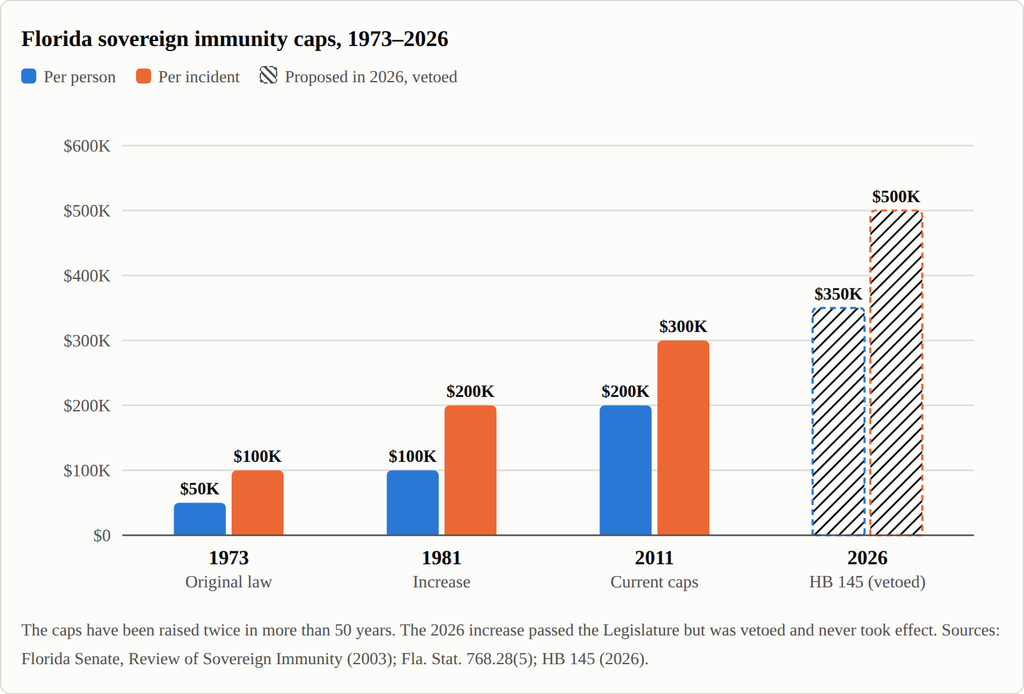
| Year | Per person | Per incident | Status |
|---|---|---|---|
| 1973 | $50,000 | $100,000 | Original law |
| 1981 | $100,000 | $200,000 | Increased |
| 2011 | $200,000 | $300,000 | Current caps (effective Oct. 1, 2011) |
| 2026 | $350,000 | $500,000 | Proposed in HB 145; vetoed June 30, 2026 |
The caps have not kept up with inflation
Adjusted for inflation, the original 1973 caps would be worth more than today’s caps. The 1973 per-person cap of $50,000 equals roughly $363,000 in 2025 dollars, about 81% more than the current $200,000 limit. Meanwhile, the cost of medical care, lost wages, and long-term care has kept rising.
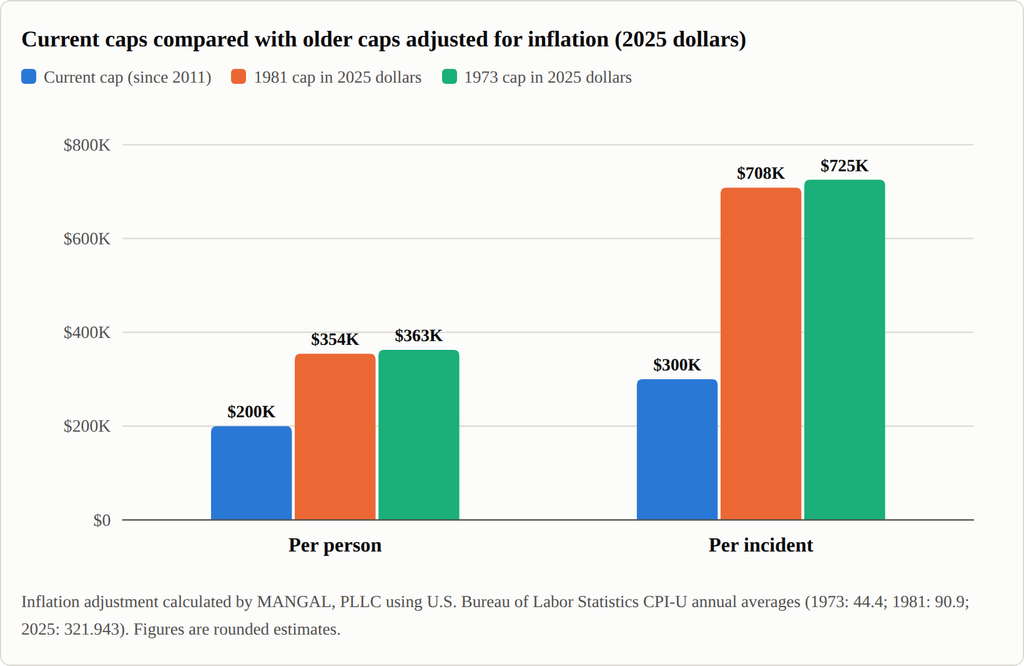
| Measure | Current cap | 1981 cap in 2025 dollars | 1973 cap in 2025 dollars |
|---|---|---|---|
| Per person | $200,000 | ≈ $354,000 | ≈ $363,000 |
| Per incident | $300,000 | ≈ $708,000 | ≈ $725,000 |
Recovering More Than the Cap: Florida Claim Bills

A jury can award more than the cap, and a court can enter a judgment for the full amount. However, the government pays only up to the cap. Under section 768.28(5)(a), any amount above the cap “may be paid in part or in whole only by further act of the Legislature.”
That “further act” is called a claim bill (sometimes called a relief act). To get one, a legislator must file and sponsor a bill for your specific case, and it must pass both chambers and be signed by the Governor. The process can take years, often involves hiring a lobbyist, and many claim bills never pass. According to a 2013 Florida TaxWatch briefing, the Legislature approved only about 25% of claim bills filed since 2000.
A government entity may also carry liability insurance. It can settle a claim within its insurance limits without legislative approval, although buying insurance does not waive the caps.
Notice Deadlines and the Presuit Process

This is where many claims against the government are lost. You cannot simply file a lawsuit. Florida requires a formal presuit notice process first, and courts treat it as a condition that must be met before a lawsuit can go forward.
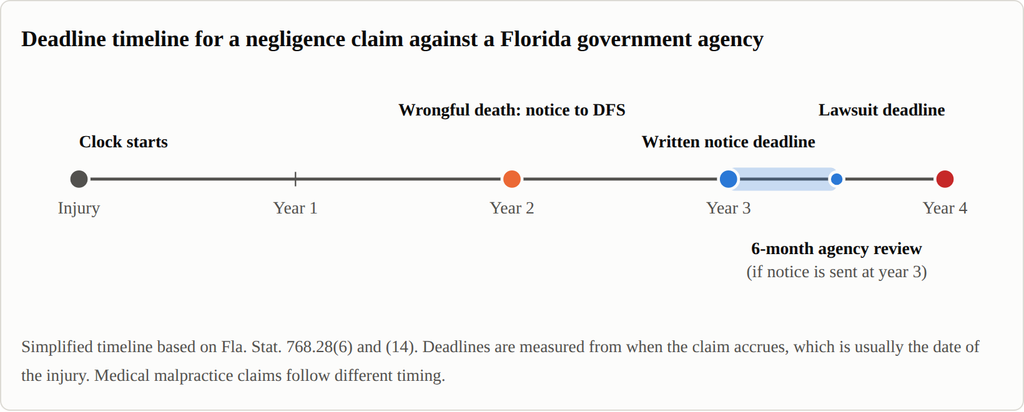
| Step | Deadline | Who gets it |
|---|---|---|
| Written notice of claim (negligence) | Within 3 years after the claim accrues | The responsible agency, plus the Department of Financial Services for claims against state agencies |
| Written notice of claim (wrongful death) | Within 2 years after the claim accrues | The Department of Financial Services (and the agency) |
| Agency investigation period | Up to 6 months (90 days for medical malpractice and wrongful death) | If there is no final decision in time, the claim is treated as denied |
| File the lawsuit (negligence) | Within 4 years after the claim accrues | Filed in the proper court and served on the agency head (and DFS for state agencies) |
| File the lawsuit (wrongful death or medical malpractice) | Shorter periods under Fla. Stat. 95.11 | Speak with an attorney immediately |
A note on HB 837: Florida’s 2023 tort reform cut the general deadline for negligence lawsuits to two years. Read more in our guide to Florida’s 2-year statute of limitations. Section 768.28(14) still sets a separate 4-year period for most negligence claims against government entities. Because a case may involve both a government defendant and a private one (for example, a crash involving a city truck and a private car), the safest approach is to act well within two years.
What the notice of claim should include
The notice must be in writing. It generally identifies the claimant, the date and place of the incident, what happened, the injuries and damages, and the amount claimed. Section 768.28(6)(c) also requires the claimant’s date and place of birth and Social Security number or federal identification number, and a statement listing any unpaid adjudicated penalties, fines, fees, restitution, or other judgments over $200. Notice that is incomplete or sent to the wrong office can put your claim at risk, which is why many people have an attorney prepare and send it by a method that proves delivery.
Other Rules That Limit Government Claims

- No punitive damages or pre-judgment interest. Section 768.28(5) bars both against government defendants.
- Attorney fees are capped at 25%. Under section 768.28(8), a lawyer cannot collect more than 25% of any judgment or settlement against the government.
- Employees are usually not personally liable. Under section 768.28(9)(a), a government employee can be sued personally only if he or she acted in bad faith, with malicious purpose, or with wanton and willful disregard of human rights, safety, or property. Otherwise, the claim goes against the agency.
- Some decisions are immune. Florida courts distinguish between “planning-level” decisions, such as whether to build a road or install a traffic light, which generally remain immune, and “operational” acts, such as maintaining an existing signal or driving a vehicle safely, which can lead to liability.
- Comparative fault still applies. Under Florida’s modified comparative negligence rule, a person found more than 50% at fault generally cannot recover damages. Our HB 837 guide explains this change.
Federal Agencies: A Different Set of Rules

Florida’s statute does not apply to federal agencies, such as the U.S. Postal Service, the VA, or military bases. Those claims fall under the Federal Tort Claims Act (FTCA). In general, you must file an administrative claim, often on Standard Form 95, within 2 years. If the agency denies the claim, you usually have 6 months to file suit in federal court. For example, a crash with a postal truck in Clermont is a federal claim, not a Florida sovereign immunity claim.
What to Do If a Government Agency Injured You
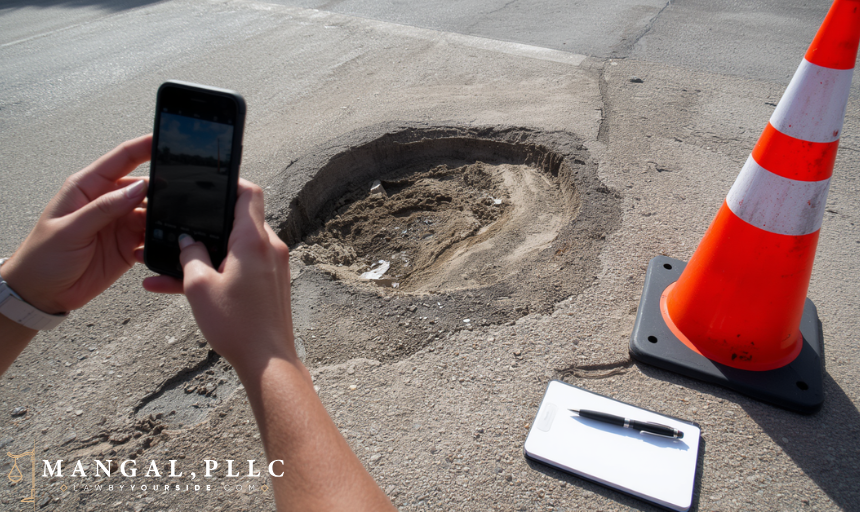
- Get medical care right away. Your health comes first, and prompt treatment also documents your injuries.
- Report the incident. Call police for any crash and get a report number. Our guide explains how to obtain a police report in Florida.
- Identify the government entity. Note the vehicle number, agency name, employee name, and exact location. For road defects, note whether it is a city, county, or state road.
- Preserve evidence. Take photos and videos, and collect witness names. Government video footage may be overwritten, so a written preservation request should be sent quickly.
- Do not give recorded statements to the agency’s risk management office or insurer before getting legal advice.
- Calendar every deadline. Track the notice, investigation, and lawsuit deadlines from the date of injury.
- Talk to a Florida personal injury attorney early so the notice is prepared correctly and served on the right offices.
Frequently Asked Questions
Can you sue a government agency in Florida?
Yes. Florida waives sovereign immunity for negligence claims under Florida Statutes section 768.28, so you can sue state agencies, counties, cities, and school boards when their employees injure you while acting within the scope of their jobs. Special notice rules and damage caps apply.
What are the sovereign immunity caps in Florida in 2026?
The caps are $200,000 per person and $300,000 per incident. A 2026 bill (HB 145) would have raised them to $350,000 and $500,000, but the Governor vetoed it on June 30, 2026, so the existing caps remain in effect.
How long do you have to notify the government of an injury claim in Florida?
For most negligence claims, you must give written notice to the responsible agency within 3 years after the claim accrues. Claims against state agencies must also be sent to the Florida Department of Financial Services. Wrongful death claims have a 2-year notice deadline.
How long does the government have to respond to a claim in Florida?
The agency generally has 6 months to make a final decision. If it does not act within 6 months, the claim is treated as denied and you may file suit. Medical malpractice and wrongful death claims have a 90-day period.
Can I recover more than the sovereign immunity cap?
A court can enter a judgment above the cap, but the government pays only up to the cap. The rest can be paid only if the Florida Legislature passes a claim bill, which is a slow and uncertain process.
Can I sue a government employee personally in Florida?
Usually not. Florida law generally protects government employees from personal liability unless they acted in bad faith, with malicious purpose, or with wanton and willful disregard of human rights, safety, or property. In most cases the claim is brought against the agency.
Injured by a Government Vehicle or on Public Property?

Claims against the government come with short deadlines, strict notice rules, and damage caps that insurers and agencies know well. At MANGAL, PLLC, attorney Avnish Mangal helps injured Floridians handle the notice process and pursue the compensation the law allows.