If you’ve been injured in a car accident in Clermont, or elsewhere in Florida, one of the most important questions in your case is not just what happened, but who was at fault and by how much.
That question now carries more weight than ever.
Recent changes to Florida law mean that your ability to recover compensation may depend on a very specific threshold. If you are found to be more than 50% responsible for the accident, you may not recover anything at all.
For many people, that comes as a surprise.
It is also one of the most misunderstood aspects of Florida personal injury law.
In this guide, we will explain how Florida’s modified comparative negligence law works, how the 51% bar rule can impact your case, and why fault has become one of the most heavily contested issues in car accident claims.
What Is Florida’s Modified Comparative Negligence Law?
Most car accidents are not black and white.
It is common for both drivers to share some level of responsibility. One driver may have been speeding, while the other made an unsafe turn. In situations like this, the law needs a way to divide fault fairly.
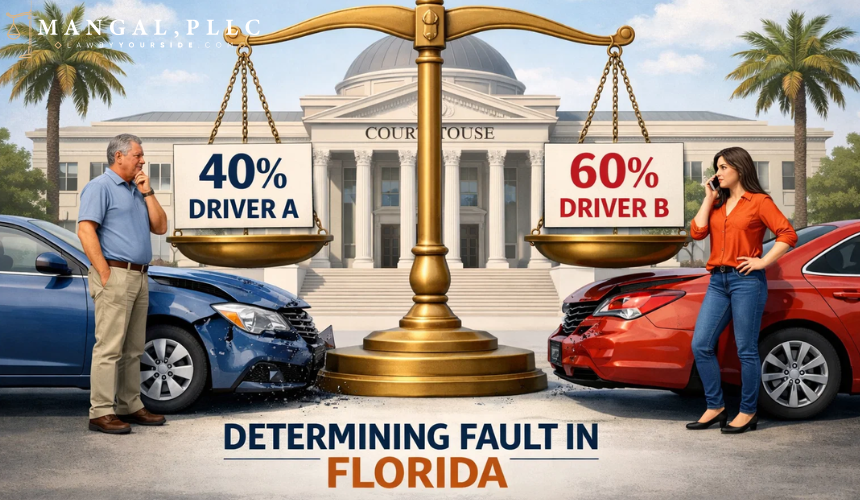
That is where comparative negligence comes in.
Comparative negligence allows responsibility to be split between the parties involved, and your compensation is adjusted based on your share of fault.
Florida’s Current Rule
Florida now follows a modified comparative negligence system for most personal injury cases, including car accidents.
This means:
- You can still recover compensation if you were partially at fault
- Your compensation is reduced based on your percentage of fault
- You are barred from recovery if you are more than 50% at fault
This is a significant change from Florida’s previous system, where even someone who was mostly responsible for an accident could still recover some damages.
Today, there is a clear cutoff point.
What Is the 51% Bar Rule in Florida?
The most important part of Florida’s current law is the 51% bar rule.

This rule sets a firm line on when you can—and cannot—recover compensation.
Here’s how it works:
- If you are 50% or less at fault, you can recover damages
- If you are 51% or more at fault, you are not entitled to any compensation
Even being slightly more responsible than the other driver can prevent you from recovering anything.
Why This Matters
That one percent difference is not just technical—it can completely change the outcome of your case.
Let’s say your damages are worth $100,000:
- At 40% fault, you could recover $60,000
- At 50% fault, you could recover $50,000
- At 51% fault, you recover nothing
Because of this, fault is no longer just part of the case—it is often the deciding factor.
How Does Partial Fault Affect My Compensation?
Even if you are not over the 51% threshold, your level of fault directly impacts how much compensation you receive.
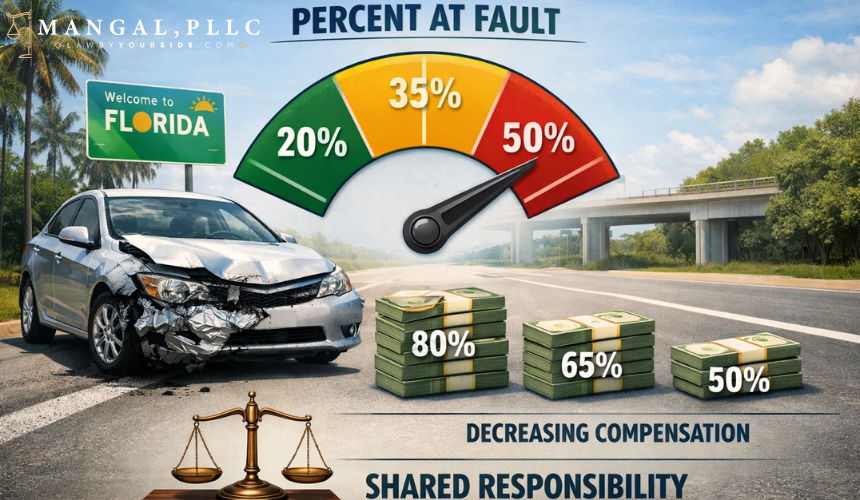
Florida law reduces your damages in proportion to your share of responsibility.
A Simple Way to Think About It
Your recovery is calculated by taking your total damages and subtracting your percentage of fault.
For example:
- If your damages are $80,000 and you are 20% at fault, you may recover $64,000
- If your damages are $100,000 and you are 35% at fault, you may recover $65,000
- If you are 50% at fault, your recovery is cut in half
Where Things Get Risky
As your percentage of fault increases, your compensation drops significantly.
And once you cross the 51% mark, the law cuts off your right to recover completely.
This is why fault allocation is so important. Even small changes in how responsibility is assigned can lead to large differences in the final outcome.
What Changed Under Florida House Bill 837?
Florida’s move to a modified comparative negligence system was part of a broader set of legal changes introduced under House Bill 837.
These changes have had a major impact on how personal injury claims—especially car accident cases are handled.
Key Changes You Should Know
1. The Shift to the 51% Rule
Before this law, Florida followed a pure comparative negligence system.
Under that system, you could recover compensation even if you were 80% or 90% at fault—your damages would simply be reduced.
Now, once you are more than 50% responsible, you are no longer eligible to recover anything.
2. Less Time to File a Lawsuit
The law also reduced the statute of limitations for negligence claims from four years to two years.
This means you now have less time to:
- Investigate your case
- Gather evidence
- File a lawsuit
Waiting too long can seriously weaken your claim.
3. More Disputes Over Fault
Because the stakes are higher, insurance companies are now more aggressive in disputing liability.
Fault is often the central issue in negotiations and litigation.
Why These Changes Matter for Your Case
These changes have made personal injury claims in Florida more complex.
What used to be a question of “how much is my case worth?” is now often:
“Will I be able to recover anything at all?”
That shift has made fault one of the most important aspects of every claim.
Why Does Fault Matter More After HB 837?
The new law has changed the dynamics of car accident claims in a very real way.

Before, even if you were mostly responsible, you could still recover something. Now, there is a hard cutoff.
1. Small Differences Can Change Everything
The difference between 49% and 51% fault is not just two percentage points.
It is the difference between recovering compensation and receiving nothing at all.
That makes fault one of the most heavily contested issues in any case.
2. Insurance Companies Have a Strong Incentive
Insurance companies are aware of the 51% rule—and they use it.
If they can push your share of fault above 50%, they may be able to deny your claim entirely.
This can involve arguments such as:
- You were driving too fast
- You were not paying attention
- You contributed to the accident
Even if the other driver was clearly negligent, the insurer may still try to shift part of the blame onto you.
3. Evidence Plays a Bigger Role
Because fault is so important, evidence can make or break your case.
This includes:
- Photos and videos from the scene
- Witness statements
- Police reports
- Vehicle damage
- Medical records
The stronger your evidence, the harder it is for insurers to increase your percentage of fault.
4. Early Mistakes Can Hurt Your Claim
What you say and do after an accident can have a lasting impact.
Statements like “I didn’t see the other car” or “I might have been going a bit fast” can later be used to argue that you were at fault.
Even a small admission can shift how responsibility is viewed.
5. Legal Representation Matters More Than Ever
Determining fault is not always straightforward. It often involves interpreting evidence, applying traffic laws, and negotiating with insurers.
Having an experienced Florida car accident attorney can help:
- Challenge unfair fault claims
- Present evidence in your favor
- Protect your right to recover compensation
In many cases, the outcome depends on how effectively fault is argued and supported.
How Do Insurance Companies Use Comparative Fault Against You?
After an accident, insurance companies are not just evaluating your injuries—they are also evaluating how to reduce their exposure.

One of the most effective ways to do that is by increasing your percentage of fault.
Common Strategies
- Blaming you for part of the accident, even when the other driver was primarily responsible
- Using your statements to suggest you admitted fault
- Downplaying the severity of the crash
- Reconstructing the accident in a way that favors their position
Because of the 51% rule, even a small increase in your fault percentage can significantly reduce—or completely eliminate—your claim.
How Is Fault Determined in a Florida Car Accident?
Fault is determined based on a combination of evidence and legal analysis.
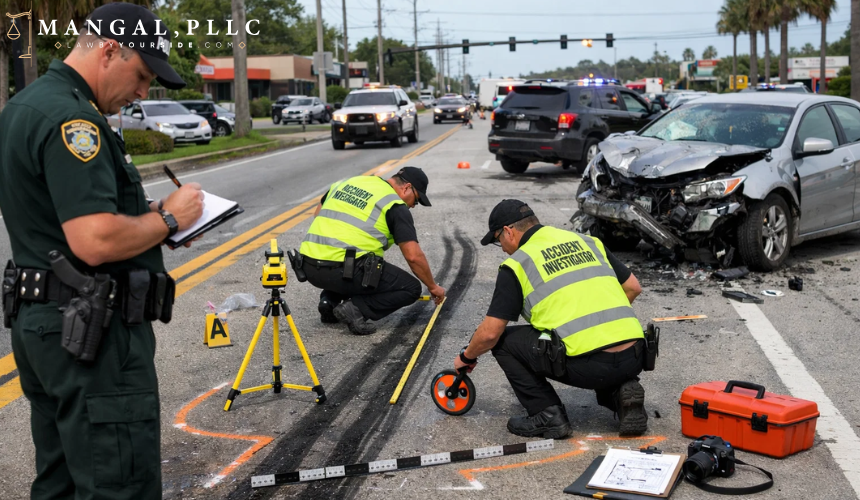
There is no single factor that decides the outcome.
Key Evidence Includes
- Police reports, which document the scene and initial observations
- Witness statements, which provide independent perspectives
- Photos and videos, which show how the accident occurred
- Physical evidence, such as vehicle damage and skid marks
- Traffic law violations, which can indicate negligence
In more complex cases, experts may be brought in to reconstruct the accident and explain what happened.
Can I Still Recover Compensation If I Was Partially At Fault?
Yes. Many people assume that being partly at fault means they cannot recover damages.

That is not true.
As long as you are 50% or less at fault, you may still recover compensation. Your recovery will simply be reduced based on your share of fault.
Partial fault is actually common in car accident cases.
The key issue is not whether you were at fault at all—but how much fault is assigned to you.
What Types of Compensation Can Be Reduced by Fault?
Fault affects every part of your claim, not just one category of damages.
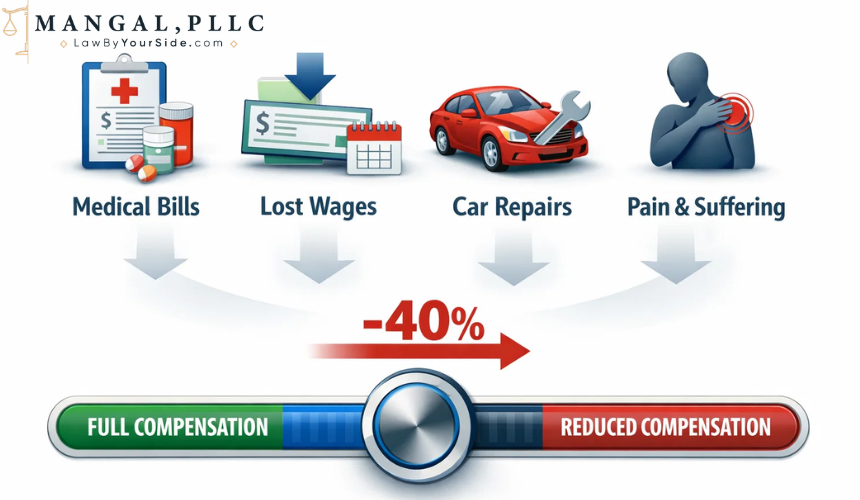
This includes:
- Medical expenses
- Lost wages
- Future earning capacity
- Pain and suffering
- Property damage
If your total damages are reduced by your percentage of fault, that reduction applies across the entire claim.
What Should I Do After a Car Accident to Protect My Claim?
Taking the right steps after an accident can make a significant difference in how fault is determined.

Practical Steps
- Seek medical attention as soon as possible
- Take photos of the accident scene and vehicles
- Gather witness information
- Avoid admitting fault or speculating about what happened
- Be cautious when speaking with insurance companies
Early action can help preserve evidence and protect your claim.
Why You Should Speak to a Florida Car Accident Lawyer Early
Under Florida’s current law, fault can determine whether your case succeeds or fails.
An experienced Florida car accident lawyer can help ensure that your claim is handled properly from the beginning.
This includes:
- Investigating the accident
- Gathering evidence
- Communicating with insurers
- Challenging unfair fault allegations
Even small changes in fault allocation can have a major impact on your case.
Florida’s modified comparative negligence law has made fault one of the most important factors in any car accident claim.
If you are found to be more than 50% at fault, you may not be able to recover any compensation at all.
Because of this, it is important to understand your rights and take steps to protect your claim from the outset.

If you have been injured in a car accident in Clermont or elsewhere in Florida, the team at MANGAL, PLLC – Florida Personal Injury Law Firm is available to review your case and help you understand your options.