
Intersection crashes are complicated — and insurance companies use that to their advantage.
Intersections are where traffic paths cross, and they’re the single most common location for serious collisions in Florida. The Federal Highway Administration has found that more than half of all traffic injuries in the U.S. happen at or near intersections. In Central Florida, where tourist traffic and fast-moving arterials mix with residential streets, the numbers are even harder to ignore.
What makes fault so difficult at intersections is that both drivers almost always claim they had the right of way. Unlike a rear-end crash — where the trailing driver is presumed at fault in most cases — intersection collisions involve competing accounts of who had the green light, who stopped, and who turned when they shouldn’t have. Sorting through those accounts requires physical evidence, traffic law knowledge, and an understanding of how Florida now assigns shared responsibility.
Florida’s right-of-way rules at intersections — the foundation of every fault analysis
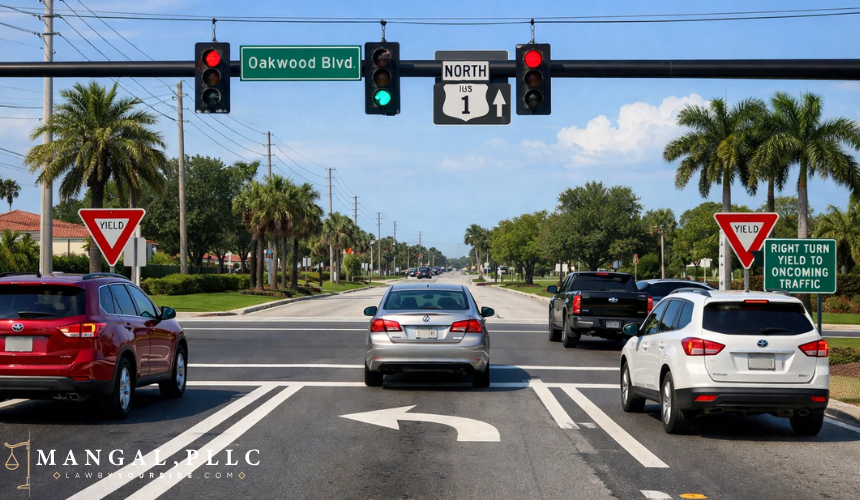
Signalized intersections
A green signal means you may proceed. Yellow means the light is about to turn red and you should stop if you can do so safely. Red means stop.
Where things get complicated: two drivers both claim they had the green, and there’s no camera footage to settle it. A driver enters on yellow just as someone else surges forward on a fresh green, and both share some fault. A traffic signal goes dark during a power outage — at that point, the intersection is legally treated as a four-way stop, and any driver who ignores that rule can be held liable.
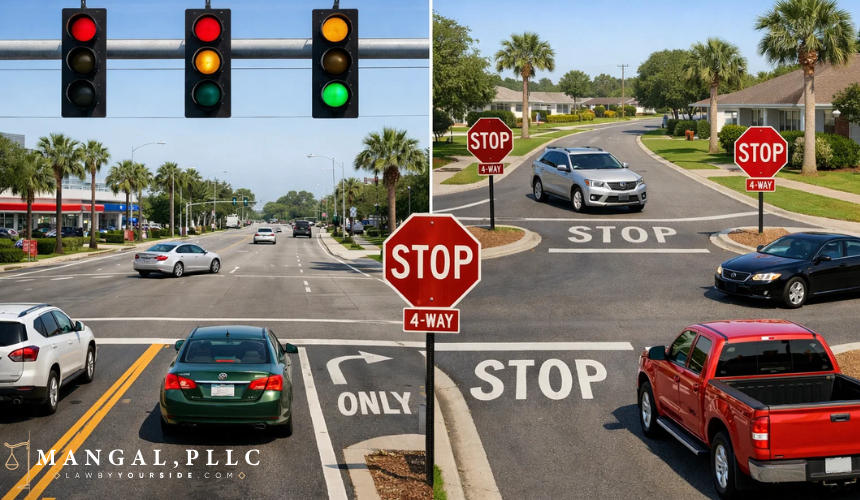
Unsignalized intersections
Stop sign and yield sign intersections run by different rules. At a four-way stop, the driver who arrives and stops first gets to go first. If two drivers stop at the same time, the driver on the right proceeds first. At a two-way stop, the driver facing the stop sign must yield to all traffic on the through road. At a yield sign, the driver must slow and yield to traffic already in or approaching the intersection.
Disputes here often come down to whether a driver actually stopped, who arrived first, and whether someone misjudged the speed of oncoming traffic. These are judgment calls — which is exactly why they’re contested.
The intersection scenarios we see most often in Central Florida
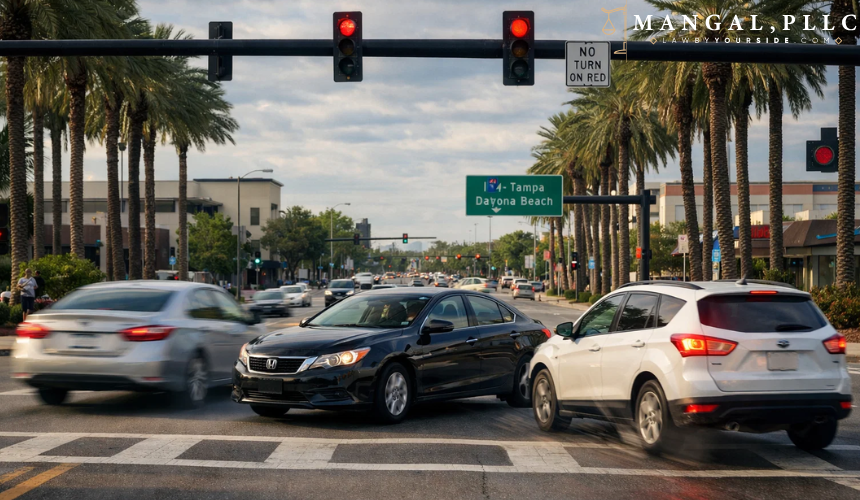
Red light violations
Red light violations produce some of the most severe intersection crashes. The driver who enters on red is almost always at fault. Proving who had the red, though, isn’t always simple. Without a red light camera or dash cam, the case may rest on witness accounts and the physical evidence of the crash itself — the angle of impact, where the damage is on each vehicle, and how far they traveled after the collision.
If your vehicle has a dash cam, don’t power it off after a crash. That footage is often the most important single piece of evidence in an intersection case.
Left turn accidents
Florida law requires left-turning drivers to yield to oncoming traffic. That makes the turning driver presumptively responsible in most left-turn collisions. But presumption isn’t proof, and the oncoming driver can share responsibility if they were speeding, ran a yellow or red light, or were distracted at the moment of impact.
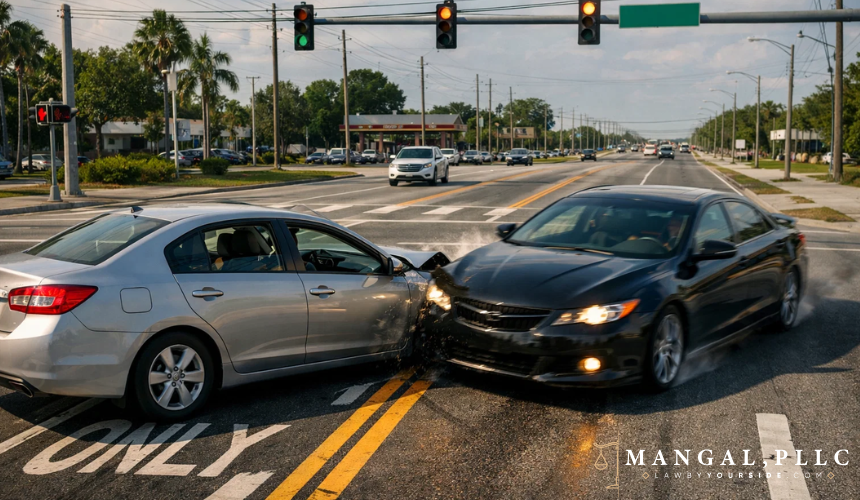
Common shared-fault scenarios in left-turn crashes: the turning driver waited for a gap but misjudged an oncoming vehicle’s speed; the oncoming driver accelerated through a stale yellow while the turning driver had already committed; the oncoming driver was on their phone and failed to brake in time. These cases almost always involve some degree of shared fault, and the percentages assigned to each driver determine how much is recoverable.
Rear-end crashes at intersections
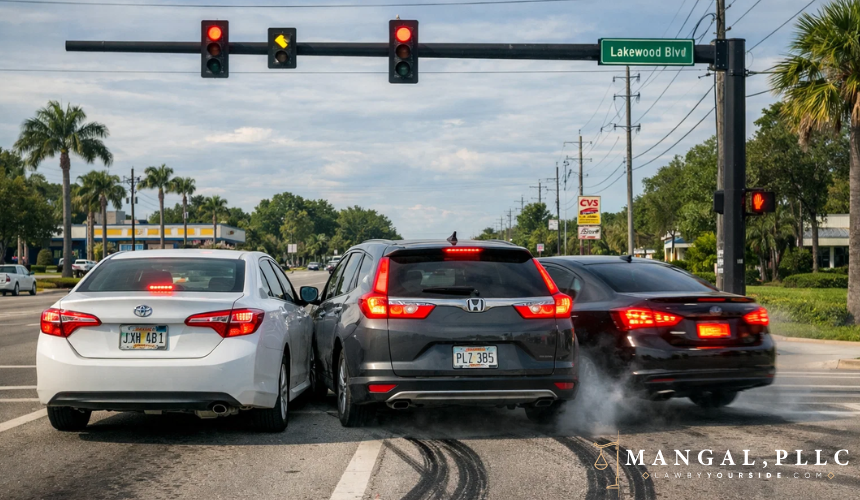
A driver who rear-ends another vehicle at an intersection is generally at fault for following too closely or failing to brake in time. The lead driver can share responsibility, though, if they stopped abruptly without reason, had non-functioning brake lights, or reversed unexpectedly.
Right turn on red failures to yield
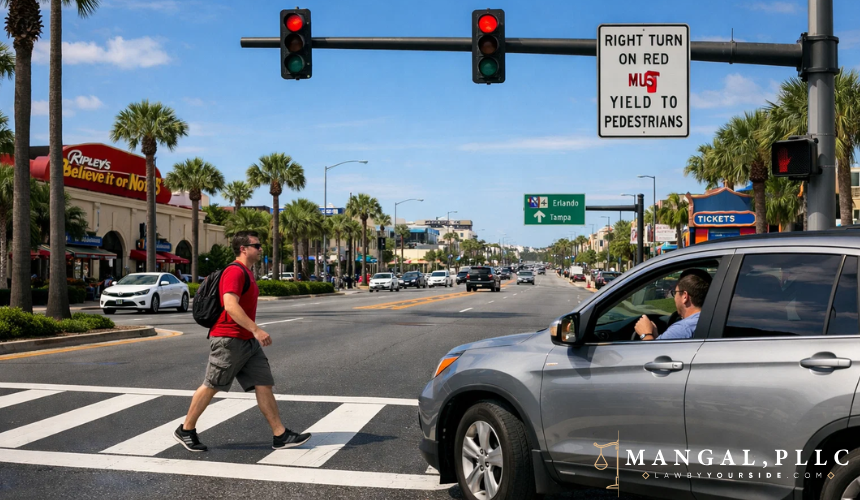
Florida allows right turns on red after a complete stop — but only when the intersection is clear. A driver who turns right on red without yielding to cross traffic or pedestrians is at fault. This comes up constantly near International Drive, major theme park corridors, and high-volume shopping areas in Orlando where pedestrian traffic is heavy and drivers are often rushing.
The evidence that actually decides intersection accident cases
Fault at an intersection is decided by evidence, not by whoever speaks louder at the scene. The stronger your evidence file, the better your chance of proving what actually happened.
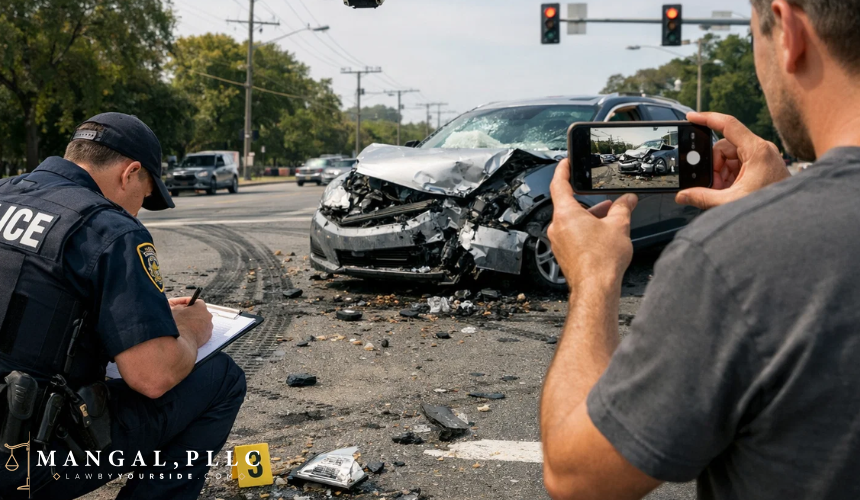
The types of evidence that matter most:
- Cameras: Traffic and red light camera footage
- Many Orlando intersections have them. Your Florida car accident attorney can request this footage before it gets overwritten — and that window is short.
- Dash cam and surveillance video from nearby businesses, ATMs, and doorbell cameras can capture the crash from useful angles.
- Police report: The responding officer’s observations and any citations issued carry real weight with insurers and juries.
- Witness statements: Independent witnesses who saw the crash from a sidewalk, another vehicle, or a nearby building can corroborate your account and are far more credible than either driver’s self-serving version.
- Vehicle damage patterns: The location and angle of damage on both vehicles helps accident reconstruction experts establish who was moving, who was stopped, and how fast each vehicle was traveling.
- Road evidence: Tire marks, gouge marks, and debris tell a story about braking, speed, and point of impact.
- Phone records: If the other driver was texting or on a call, phone records can establish distraction.
If you’re physically able after an intersection crash, photograph everything before you leave the scene — the road, the vehicles, the traffic signals, the damage, skid marks, and the surrounding area. Get contact information from any witnesses. Physical evidence disappears faster than most people expect.
How Florida’s comparative negligence rule plays out in intersection cases
Intersection accidents almost always involve arguments about shared fault. The other driver’s insurer will nearly always claim you bear some responsibility — even when the other driver clearly ran a light or failed to yield.
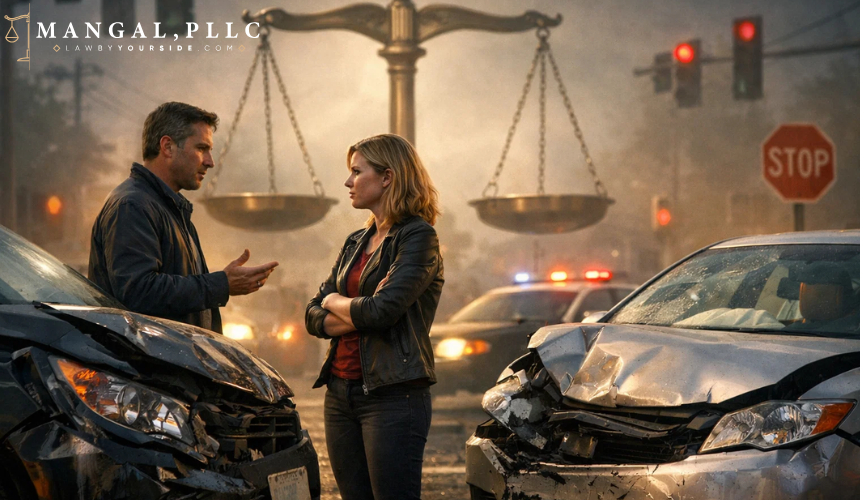
Under Florida’s modified comparative negligence rule, effective March 24, 2023: if you’re 50 percent or less at fault, you recover damages reduced by your percentage. If you’re 51 percent or more at fault, you recover nothing.
Here’s a real example of how this plays out. You’re turning left at a major Orlando intersection. The oncoming driver runs a late yellow that turns red, and you collide in the intersection. A jury finds $200,000 in total damages, assigns you 20 percent fault for initiating the turn and 80 percent to the other driver for running the light. You recover $160,000.
Now flip the percentages. The jury decides you were 55 percent responsible for turning too early. You recover nothing. That’s the reality of modified comparative negligence, and it’s why the quality of your evidence — and your personal injury attorney‘s ability to present it — changes the outcome.
Pedestrians and cyclists at intersections
Florida law requires drivers to yield to pedestrians in crosswalks, including unmarked crosswalks at intersections. Drivers turning right on red must yield to pedestrians with the walk signal. But pedestrians have obligations too. Walking against a signal, darting into traffic outside a crosswalk, or crossing while distracted can result in shared fault.
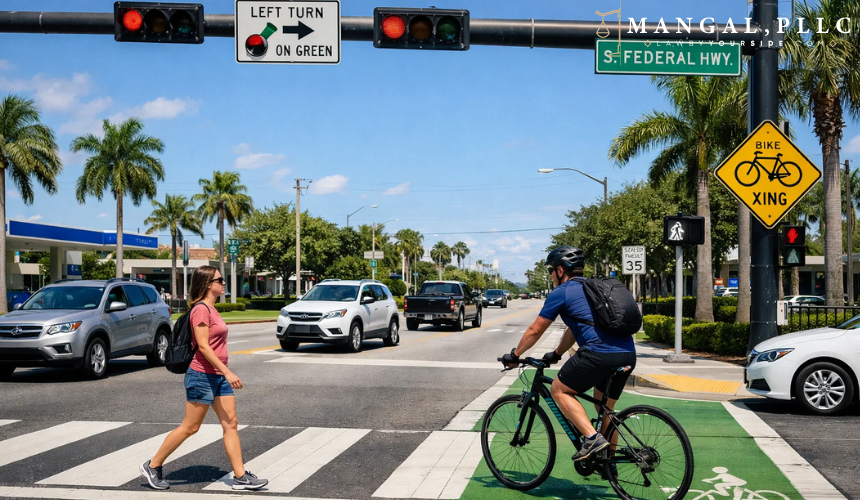
Under modified comparative negligence, a pedestrian found more than 50 percent at fault is barred from recovery. Cyclist intersection crashes follow similar principles — a cyclist riding lawfully through a green who gets hit by a turning vehicle has a strong claim; a cyclist who blows a red light and collides with cross traffic faces serious fault arguments.
How insurance companies fight intersection accident claims
The tactics are predictable. Blaming you for not seeing the other vehicle and reacting sooner. Arguing you were moving too fast, even if you had the right of way. Claiming the signal was yellow, not red, when their insured entered. Using your own recorded statement against you if you speculated about what happened. Challenging the severity of your injuries and labeling them pre-existing.
Every one of these arguments can be countered. At MANGAL, PLLC – Florida Personal Injury Law Firm, we deal with them daily. We know how insurers build these cases and how to dismantle them.
Questions People Ask About Intersection Accident Fault in Florida
If both drivers claim they had the green light, how does the court decide?
Physical evidence usually breaks the tie. Camera footage is the strongest. Without it, courts look at the angle and location of vehicle damage, skid marks, witness testimony, and the police report. An accident reconstruction expert can analyze the physics of the crash to determine which version of events is consistent with the evidence.
Does a police report determine who’s at fault?
It’s an important piece of evidence, not the final word. The officer’s observations and any citations carry weight with insurers and juries, but fault is ultimately determined through the claims process or by a jury at trial. Officers sometimes get it wrong, and a Clermont car accident attorney can challenge the report with additional evidence.
What if a traffic light was malfunctioning during the accident?
When a signal malfunctions or goes dark, the intersection is legally treated as a four-way stop. Every driver must stop and proceed in order of arrival. A driver who treats a dark signal as a green and proceeds without stopping can be held liable. In some cases, the government entity responsible for maintaining the signal may share fault.
Can I recover compensation if I was partially at fault?
Yes, as long as your fault doesn’t exceed 50 percent. Your compensation is reduced by your percentage of fault. If a jury finds you 30 percent at fault and awards $100,000, you receive $70,000. Exceed 50 percent and you receive nothing.
What should I do right after an intersection accident?
Stay at the scene. Call 911. Check for injuries. Photograph the vehicles, the intersection, traffic signals, and any damage. Get the other driver’s information and the contact details of any witnesses. Don’t admit fault or speculate about what happened. Seek medical attention the same day, even if you feel fine. Then call an Florida personal injury Lawyer before speaking with any insurance company.
Injured in an Intersection Accident in Central Florida?
Intersection crash cases are rarely simple. The other driver’s insurer will work to push blame onto you, and under Florida’s modified comparative negligence rule, that strategy has real teeth. You need someone who knows how to gather the right evidence early, counter the insurer’s arguments, and protect your right to fair compensation.
At MANGAL, PLLC – Florida Personal Injury Law Firm, Attorney Avnish Mangal personally handles every case. We’re available 24/7, rated 5 stars on Google and Avvo, and have represented more than 1,000 clients across Central Florida. Contact us through MANGAL, PLLC – Florida Personal Injury Law Firm for a free consultation. Whether your crash happened in Orlando, Clermont, or anywhere in Central Florida, we’re ready to fight for you.